🍪 We use cookies
We use cookies to enhance your experience, analyze site traffic, and for marketing purposes. By clicking "Accept All", you consent to our use of cookies. Read our Privacy Policy


Do you advise and educate patients everyday in your practice?
Where you trained how to teach?
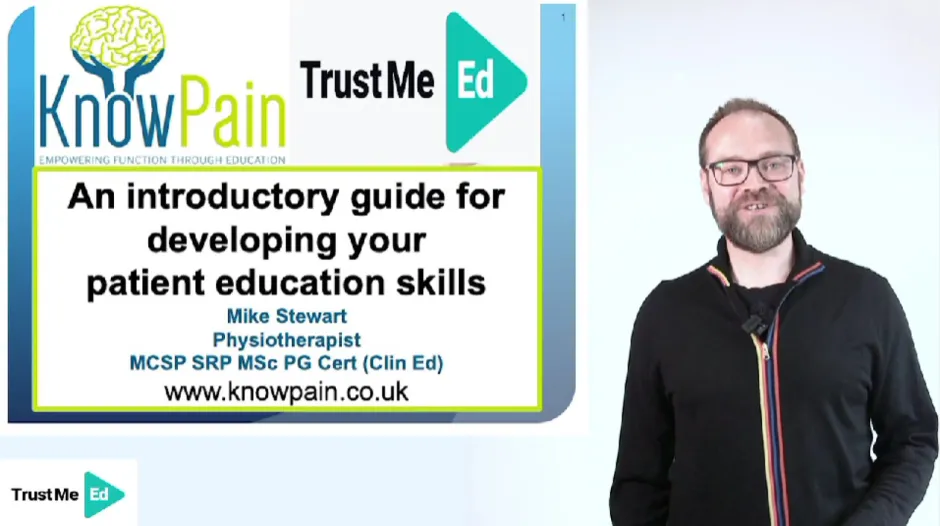
Helping people make sense of pain and distress is a daily challenge for healthcare professionals. Patient education forms a significant component of modern-day, evidence-based practice. However, many clinicians have a limited educational toolkit as less than 1% of all healthcare training teaches us the necessary knowledge and skills that are needed to guide and facilitate learning.
This lecture will introduce you to evidence-based educational theories to help you optimize your patient education skills. You will discover practical ways to develop empowerment, to understand the importance of experiential learning, and to learn how to develop a therapeutic alliance by exploring the dynamic relationship between how much you challenge patients and how much you support them.
Learning Points:
1. Explore current issues regarding patient-centered education in healthcare
2. Reflect upon challenges you face when educating patients in practice
3. Expand your teaching toolkit by measuring creativity & developing serious playfulness
4. To understand the importance of experiential learning in healthcare
5. Learn how the dynamic relationship between challenge and support can have either a positive or negative impact on empowerment & therapeutic alliance
"Know Pain courses help you develop a range of practical, engaging skills which you can start using immediately in your clinic."
This is a comment from a physiotherapist who has attended a Know Pain course: "I connect so much better with my patients since attending this course."
To book your place on a Know Pain course, and to take advantage of the 20% discount for TrustMeEd members, email [email protected] or visit www.knowpain.co.uk and mention you are a Trust me-Ed member.
Why patient education is a large part of physiotherapy that clinicians are rarely trained for, the strengths and limits of common delivery methods, and the core skills patients need from their clinician.
How education means drawing knowledge out of patients rather than pouring it in, why paternalistic language persists in physiotherapy, and how shared decision making and the driving instructor model support empowerment.
How creativity and serious playfulness can be used in patient education, using Guilford's Alternative Uses Task to help patients design their own home exercises and attach meaning to them.
Why information alone rarely changes behavior, and how experiential learning, a Chinese finger trap demonstration and Kolb's experiential learning cycle help patients learn by feeling and doing rather than being told.
How to balance challenge and support with patients using Daloz's model, a dark room thought experiment for gauging confidence, and practical ways to check what a patient has actually learned.
Do you advise and educate patients everyday in your practice?
Where you trained how to teach?
Helping people make sense of pain and distress is a daily challenge for healthcare professionals. Patient education forms a significant component of modern-day, evidence-based practice. However, many clinicians have a limited educational toolkit as less than 1% of all healthcare training teaches us the necessary knowledge and skills that are needed to guide and facilitate learning.
This lecture will introduce you to evidence-based educational theories to help you optimize your patient education skills. You will discover practical ways to develop empowerment, to understand the importance of experiential learning, and to learn how to develop a therapeutic alliance by exploring the dynamic relationship between how much you challenge patients and how much you support them.
Learning Points:
1. Explore current issues regarding patient-centered education in healthcare
2. Reflect upon challenges you face when educating patients in practice
3. Expand your teaching toolkit by measuring creativity & developing serious playfulness
4. To understand the importance of experiential learning in healthcare
5. Learn how the dynamic relationship between challenge and support can have either a positive or negative impact on empowerment & therapeutic alliance
"Know Pain courses help you develop a range of practical, engaging skills which you can start using immediately in your clinic."
This is a comment from a physiotherapist who has attended a Know Pain course: "I connect so much better with my patients since attending this course."
To book your place on a Know Pain course, and to take advantage of the 20% discount for TrustMeEd members, email [email protected] or visit www.knowpain.co.uk and mention you are a Trust me-Ed member.
We usually answer within a minute.
Ask anything about your membership, certificates or what is in the library.
No comments yet…