🍪 We use cookies
We use cookies to enhance your experience, analyze site traffic, and for marketing purposes. By clicking "Accept All", you consent to our use of cookies. Read our Privacy Policy


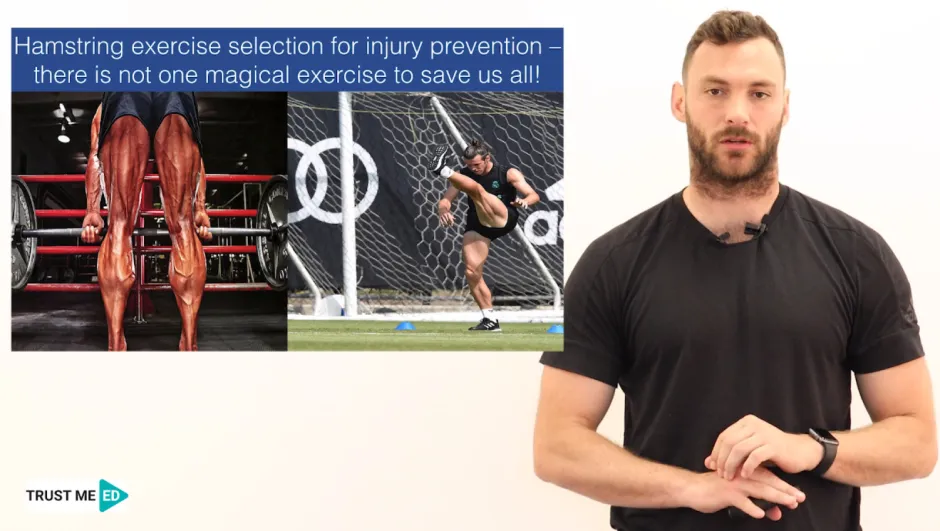
This presentation focussed on highlighting considerations for hamstring exercise selection for injury prevention practices. The key points from this presentation are:
- When programming for hamstring injury prevention, the question shouldn’t be what is the best exercise, but what is the adaptation I want to achieve?
- Then you have a range of exercises to choose from base upon your goal.
- Each of these exercises will have a different benefit than the other, with not one being the best.
- The range of variables that need to be considered when selecting a hamstring injury prevention exercise are large and include items such as: exercise contraction mode, activation profile, range of excursion.
- Furthermore programming these exercises creates more questions around the volume, intensity, frequency, velocity and laterality.
This presentation then works through a range of these variables, providing evidence to help guide you towards determining the best exercise for your determined adaptation.
Learning objectives
> You should be able to discuss variables to consider when selecting exercises and address the programming variables that need to be questioned in this matter.
> You should be able to determine whether or not different examples of hamstring exercises will be beneficial for your case (or patient).
Discover how smarter hamstring exercise selection can improve injury prevention by matching each exercise to a specific goal, from building eccentric strength to increasing muscle size and fascicle length. Learn why no single drill does it all, and how volume, intensity, running speed, and consistency shape better results.
Discover why hamstring injuries happen so often in sport and what actually helps reduce the risk. Ryan Timmins breaks down the key role of eccentric strength, high-speed running exposure, and simple training principles that can make prevention more effective.
This presentation focussed on highlighting considerations for hamstring exercise selection for injury prevention practices. The key points from this presentation are:
- When programming for hamstring injury prevention, the question shouldn’t be what is the best exercise, but what is the adaptation I want to achieve?
- Then you have a range of exercises to choose from base upon your goal.
- Each of these exercises will have a different benefit than the other, with not one being the best.
- The range of variables that need to be considered when selecting a hamstring injury prevention exercise are large and include items such as: exercise contraction mode, activation profile, range of excursion.
- Furthermore programming these exercises creates more questions around the volume, intensity, frequency, velocity and laterality.
This presentation then works through a range of these variables, providing evidence to help guide you towards determining the best exercise for your determined adaptation.
Learning objectives
> You should be able to discuss variables to consider when selecting exercises and address the programming variables that need to be questioned in this matter.
> You should be able to determine whether or not different examples of hamstring exercises will be beneficial for your case (or patient).
We usually answer within a minute.
Ask anything about your membership, certificates or what is in the library.
No comments yet…