Ankle Sprain Rehabilitation: Prioritising Balance and Stability
Ankle sprains are among the most common musculoskeletal injuries.
While rehabilitation often focuses on restoring range of motion and strength, there are key elements that are frequently overlooked—particularly those related to postural control and balance strategies.
If you want to learn more about this topic, you can watch Eamonn Delahunt's lecture here:
Understanding Balance Deficits After Ankle Sprain
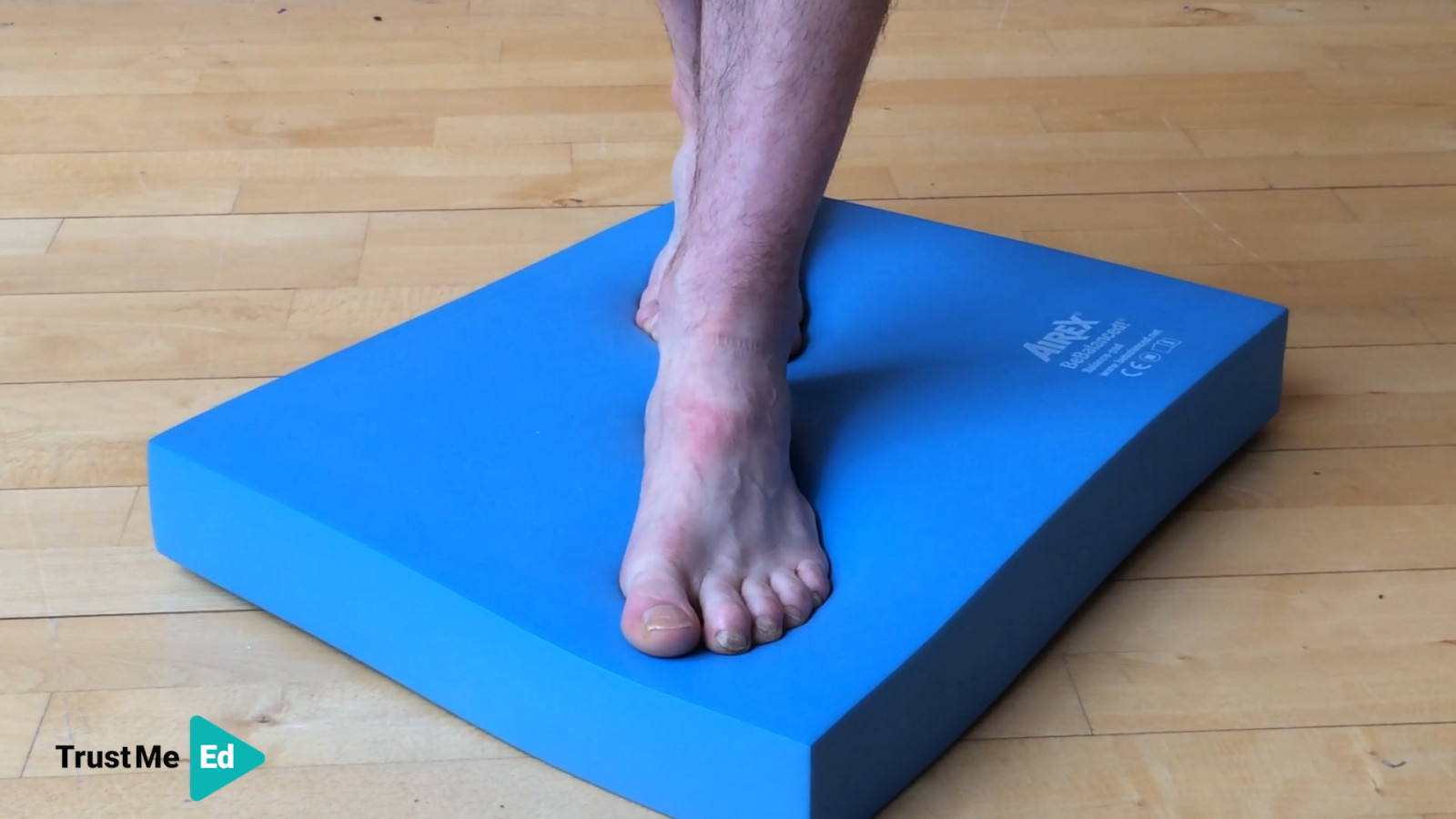
Even after pain and swelling subside, individuals may continue to demonstrate impaired postural control. One useful way to assess this is through the Balance Error Scoring System or the BESS test. The test involves maintaining balance in different positions (e.g., single-leg stance, tandem stance) on firm and foam surfaces, while the clinician records postural errors.
Common errors include:
→ Lifting hands off hips
→ Opening eyes
→ Stepping or stumbling
→ Lifting the forefoot or heel
→ Remaining out of position for more than 5 seconds.
How do we interpret the BESS test?
More errors = poorer balance performance
Higher scores may indicate deficits in postural control. It can help identify impairments in individuals with ankle sprain or chronic ankle instability
Ankle strategy vs hip strategy: A key concept
Postural control relies on coordinated contributions from different joints.
1.Ankle strategy:
Small, subtle adjustments at the ankle used for minor balance disturbances.
2.Hip strategy:
Larger, faster movements used for greater perturbations.
After an ankle sprain, individuals often shift from an efficient ankle strategy to a more dominant hip strategy.
Over time, the ankle may become stiff or “frozen”, reducing its ability to contribute effectively to balance.
Why restoring ankle strategy matters?
If ankle strategy is not addressed during rehabilitation, the ankle becomes less responsive and patients rely excessively on proximal compensations. Balance deficits may persist so rehabilitation should aim to restore ankle-driven postural control.
How to improve balance and restore ankle strategy?
Improving ankle strategy requires a combination of mobility, sensory input, and progressive balance challenges.
1. Restore ankle and foot mobility
Restricted mobility can limit the ankle’s ability to respond to balance demands.
Focus on:
☑ Improving dorsiflexion
☑ Festoring ankle and midfoot movement
☑ Encouraging triplanar motion
☑ Manual therapy and active mobility exercises can support this.
2. Start With Single-Leg Balance
Single-leg stance encourages the ankle to make small corrective movements.
Progress by:
☑ Increasing duration
☑ Adding reaching tasks
☑ Performing eyes closed
3. Use Unstable Surfaces
Unstable surfaces increase the demand on the ankle.
Examples:
• Wobble board
• Balance board
• BOSU
• These challenge proprioception and neuromuscular control.
4. Enhance Sensory Input
Training barefoot can improve plantar sensory feedback, helping the nervous system detect and respond to balance changes more effectively.
5. Progress to Dynamic Tasks
Once basic balance is achieved, introduce:
✔ Hopping drills
✔ Direction changes
✔ Perturbation training
This prepares patients for real-life and sport-specific demands.
6.Role of Manual Therapy
Following an ankle sprain, joint mobility restrictions, especially in dorsiflexion—are common.
Manual therapy can help:
✔ Festore joint mechanics
✔ Improve movement quality
✔ Support the return of ankle strategy
However, it should be combined with active rehabilitation.
7.Don’t forget the uninjured limb
Training the uninjured limb, even in the acute phase, can be beneficial.
Due to cross-education within the nervous system:
☑ Improvements can transfer to the injured side
☑ Neuromuscular function can be maintained
early balance training can begin safely.
Importance of Hip Strength
When ankle strategy is impaired, the body often relies more on the hip strategy.
Strengthening the hip abductors and external rotators helps:
→ Maintain pelvic stability
→ Reduce compensations
→ Improve postural control
Weakness may present as a Trendelenburg pattern during single-leg tasks.
Useful exercises include:
• Hip hitch
• Figure-4 exercise
Integrating it all: A comprehensive approach
Thus, effective ankle sprain rehabilitation should include:
✔ Restoring ankle and foot mobility
✔ Assessing and improving balance (e.g., BESS test)
✔ Retraining ankle strategy
✔ Progressing balance exercises
✔ Strengthening the hip and lower limb
✔ Training the uninjured limb early
If you want to learn more about this topic, you can watch Eamonn Delahunt's lecture here: