🍪 We use cookies
We use cookies to enhance your experience, analyze site traffic, and for marketing purposes. By clicking "Accept All", you consent to our use of cookies. Read our Privacy Policy
There has been an increase in incidents of ACL injuries over the last couple of years (1). According to a systematic review and meta-analysis, only 55% of people with anterior cruciate ligament reconstruction surgery return to competitive sport (2). One-fourth of individuals younger than 25 years will get a second ACL injury after going through ACL reconstruction surgery (3).
We should use an objective return to sport criteria after ACL reconstruction. According to a review conducted in 2011, only 13% of the studies in literature used an objective return to sport (RTS) criteria to decide whether a player should or shouldn’t return to sport (4).
The deficit in existing, non-objective criteria is that most of these criteria are:
A study included 115 athletes with ACL reconstruction cleared by the medical team to return to sports. After some tests and questionnaires to evaluate whether these athletes were ready to return to sports, only 14% of the athletes reached the cut-off criteria set by the authors (5). The main reason for not reaching up to the cut-off criteria appears to be the uncontrolled rehabilitation process.
These are significant limitations of current approaches and rehabilitation processes addressing ACL injuries.
We need novel ideas to optimize the rehabilitation process for the patient with ACL reconstruction surgery. The use of the biopsychosocial approach can improve athlete’s return to sport (RTS). It is important to consider psychological and social factors along with the physical during the rehabilitation process of athletes with ACL reconstruction (6).
Psychological aspects of ACL reconstruction rehabilitation (6)
Psychological factors play a significant role in an athlete’s return to sport. The psychological factors that can affect an athlete’s recovery and return to sport (RTS) are listed below:
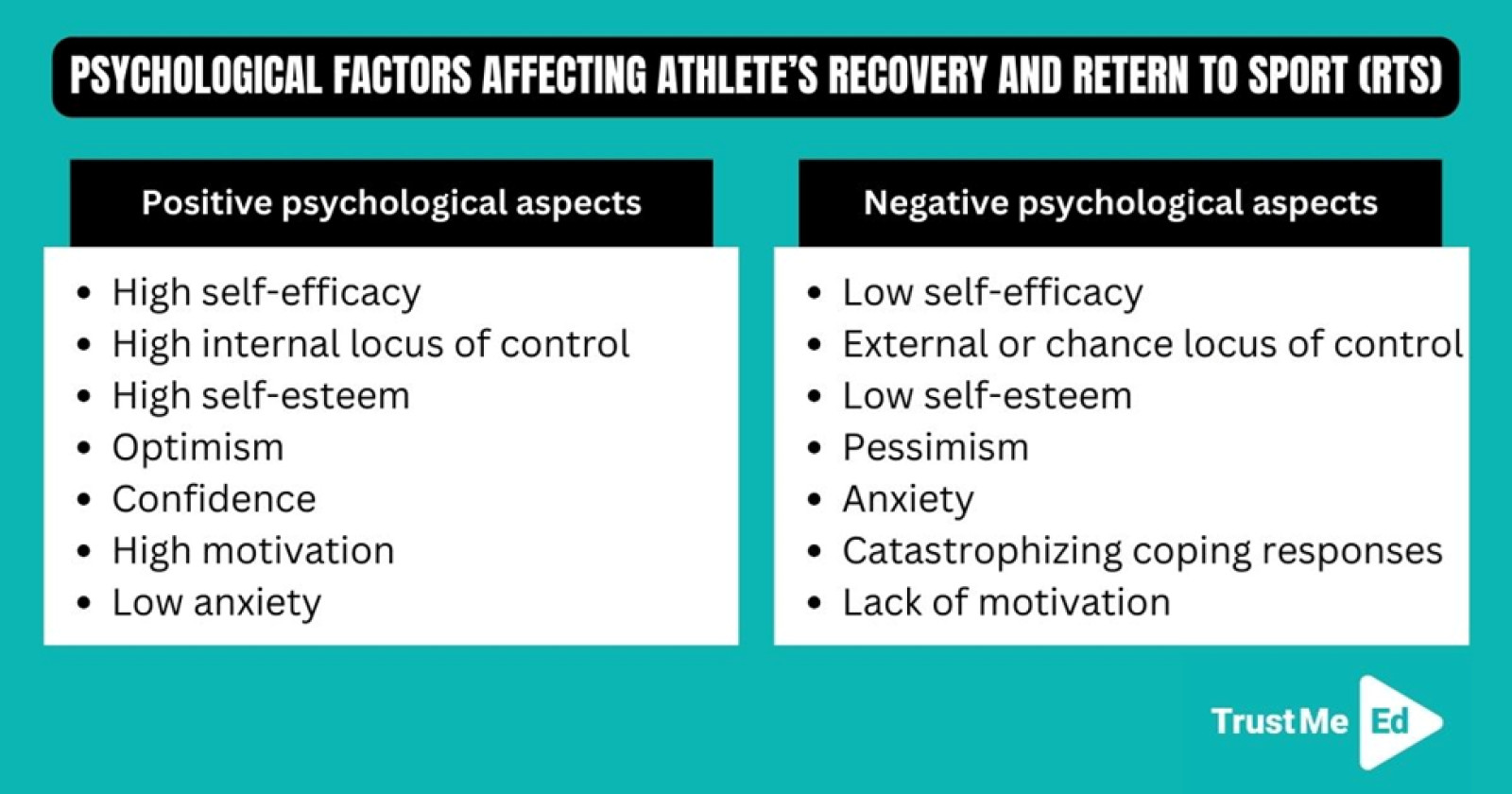
We can assess the psychological factors by using questionnaires, such as ACL Return to Sport After Injury Questionnaire that assess different psychological aspects of the patient that affect the patient’s return to sport, like confidence in knee and confidence in performing relevant sport, etc (6).
Psychological interventions to improve athlete’s recovery
Existing literature provides us with psychological interventions for clinical practice during ACL rehabilitation. These potential psychological interventions include (7):
Many clinicians approach ACL injury as a simple mechanical problem, which is not optimal according to the current literature. ACL not only restraints the tibia from anterior translation under the femur but also plays a sensorimotor function. Sensory nerves innervate the ACL at its proximal and distal ends. These nerve endings send sensory signals to the CNS, which in turn help with proprioception. This sensorimotor role is of great importance (8).
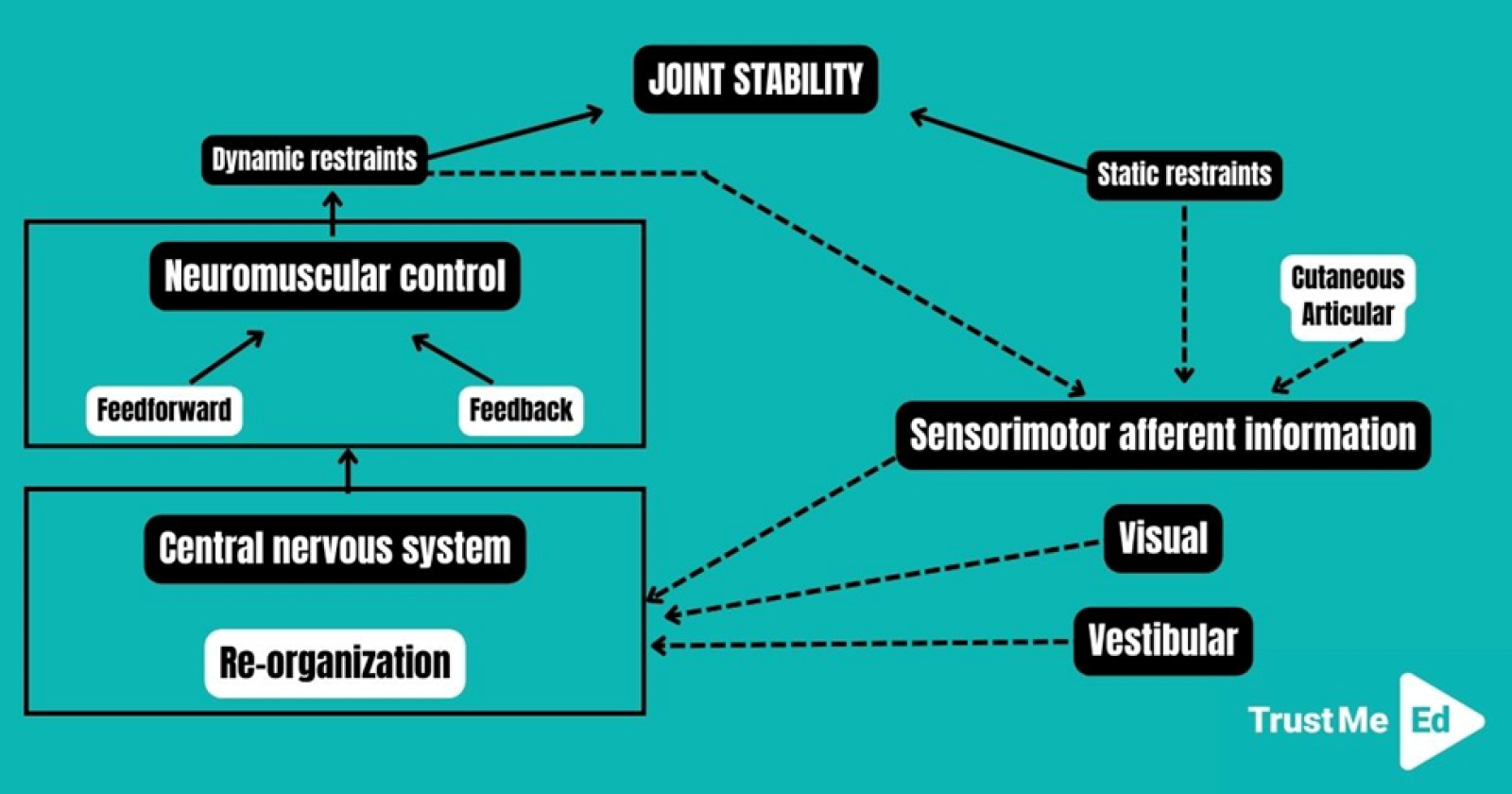 Reproduced from Bart Dingenen – ACL rehab
After ACL injury, CNS re-organizes itself, and if not re-educated and trained effectively, it can result in maladaptive CNS responses. The effective way to tackle this problem is to adopt targeted CNS re-education training (9).
The better way to enhance the effectiveness of ACL rehabilitation is by (9):
The contemporary literature suggest that patients’ integration in the rehabilitation process is essential to increase their adherence to and involvement in the process (6).
The two most common approaches utilized for ACL rehabilitation are (10):
Traditional training utilizes vision via motor control compensations, a compensatory sensorimotor control strategy. It uses overreliance on visual feedback for motor control.
Integrated motor visual training uses modified visual feedback training with minimal visual reliance to improve sensory-motor function.
The flowchart below shows how both approaches work and the conceptual training model for ACL rehabilitation:
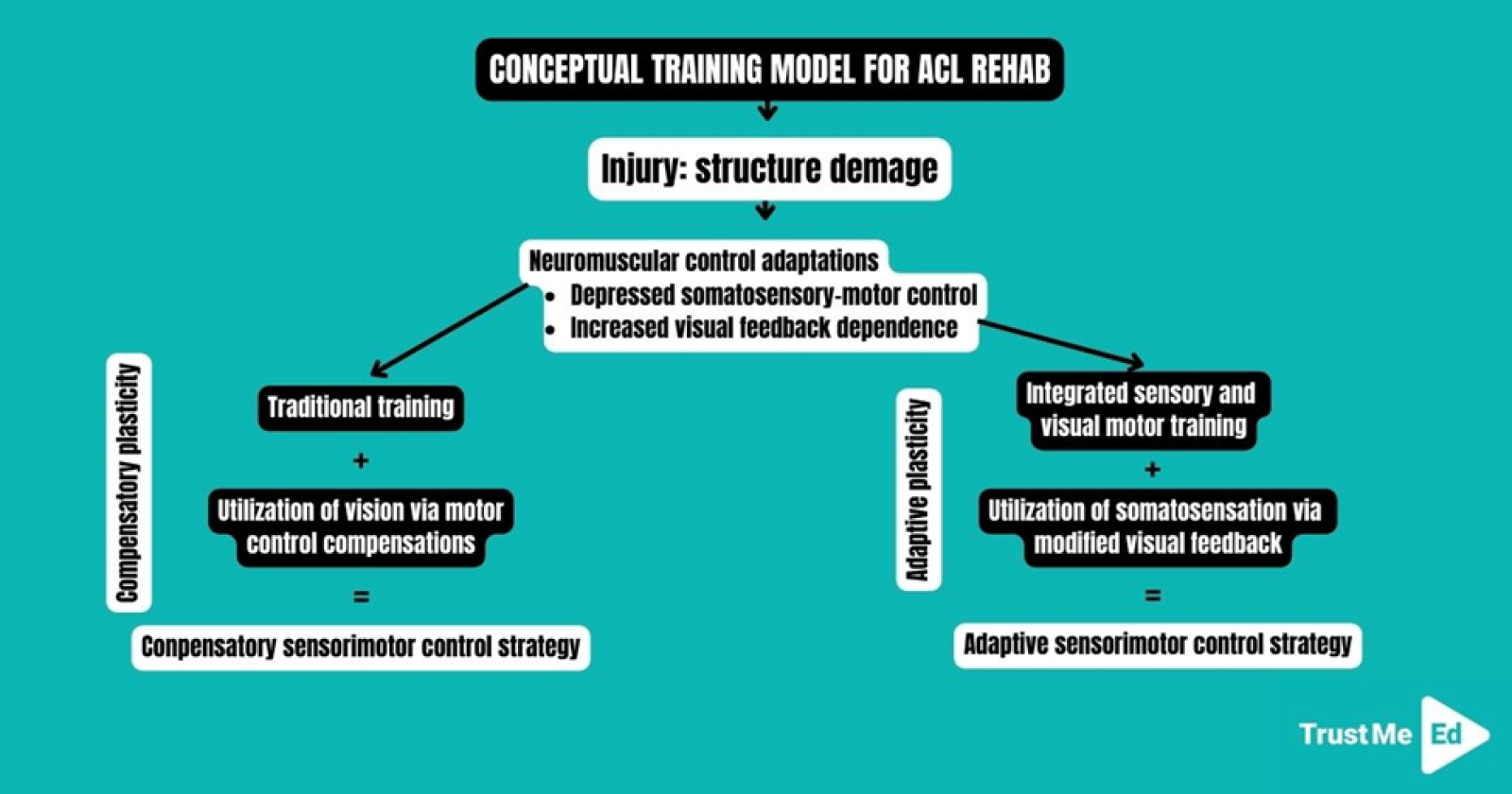 Reproduced from Grooms, Appelbaum, and Onate, 2015
The training environment should mimic the athlete’s sport environment. A closed environment with specific tasks cannot provide the actual field experience.
A player in the field moves quickly in different directions in response to the movement of other players. So, a closed environment cannot provide such a dynamic experience.
The rationale behind an open environment with dynamic exercises is to develop a better action and perception coupling in the athlete to improve the athlete’s physical performance.
The ACL rehabilitation should be structured in a step-wise fashion to meet an objective criteria for return to sport (RTS) to prevent future ACL injury.
The diagram below clearly illustrates the path to be followed for ACL rehabilitation:
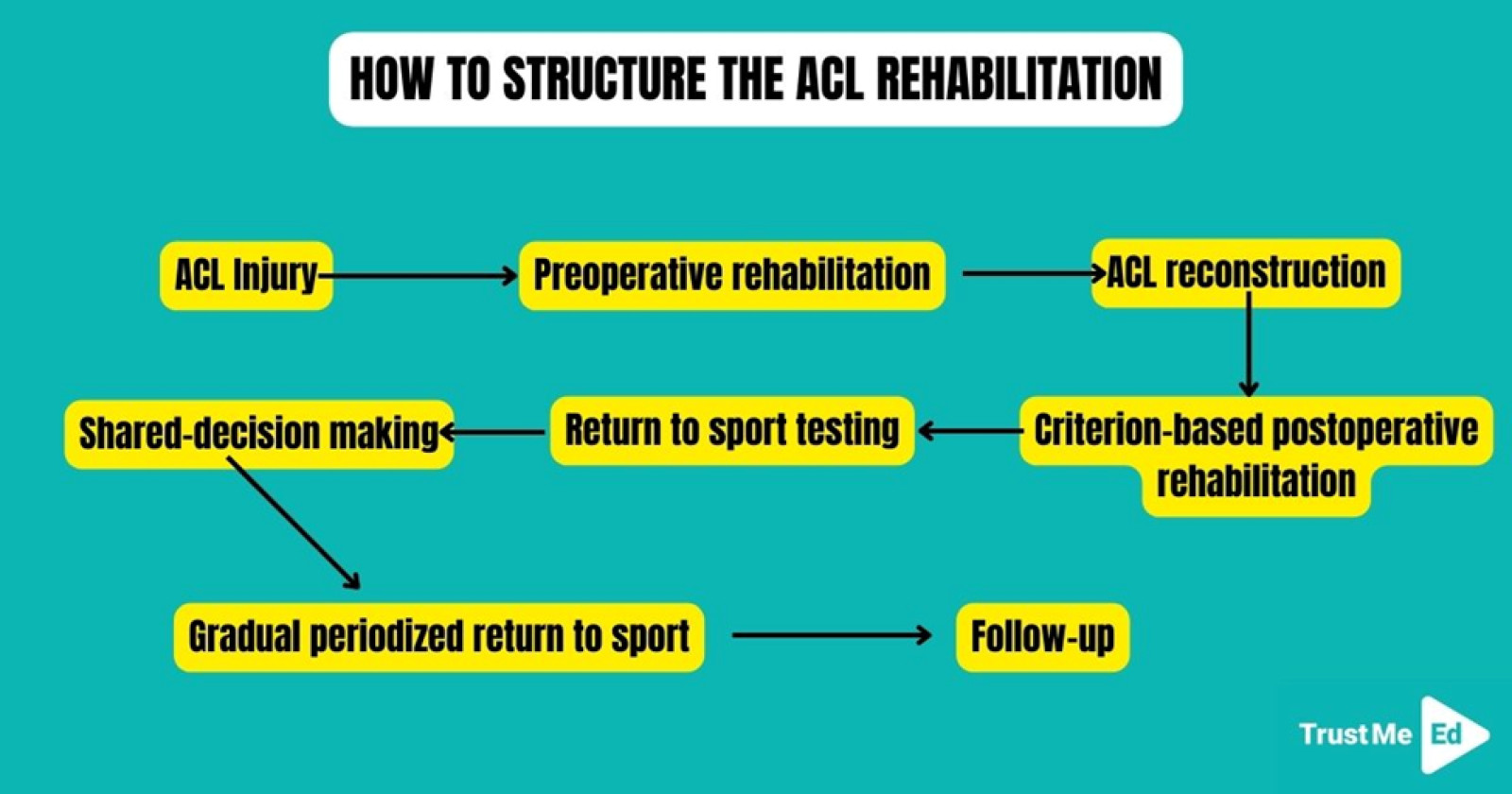 Reproduced from Dingenen & Gokeler, 2017
Here, we will briefly discuss the main steps for ACL rehabilitation. If you want to learn the detailed ACL rehabilitation process, you can have a look at the lecture by Bart Dingenen on ACL Rehabilitation.
Rehabilitation starts before ACL reconstruction. Preoperative extension deficit and quadriceps weakness can result in significant suboptimal outcomes postoperatively.
The activity participation goals for preoperative rehabilitation include:
STAGE-1
The functional goals for this stage include:
Patient Education
Pain, effusion, and inflammation management
The activity participation goals for this stage include:
Criteria to start STAGE-II
The functional goals for this stage include:
The activity participation goals for this stage include:
Criteria to start STAGE-III
The functional goals for this stage include:
The activity participation goals for this stage include:
Return to sport is a multifactorial problem. We have to consider different aspects within our clinical reasoning process. Timing of return to sport is a significant factor to consider while planning to return to sport. For every month the return to sport is delayed until nine months after ACL reconstruction surgery, the re-injury rate reduces by 51% (12).
Another major factor to consider is symmetrical quadriceps strength. More symmetrical quadriceps strength before return to sport can reduce the knee re-injury rate significantly (12).
The figure below shows the steps to follow from the rehabilitation process to performing on the field:
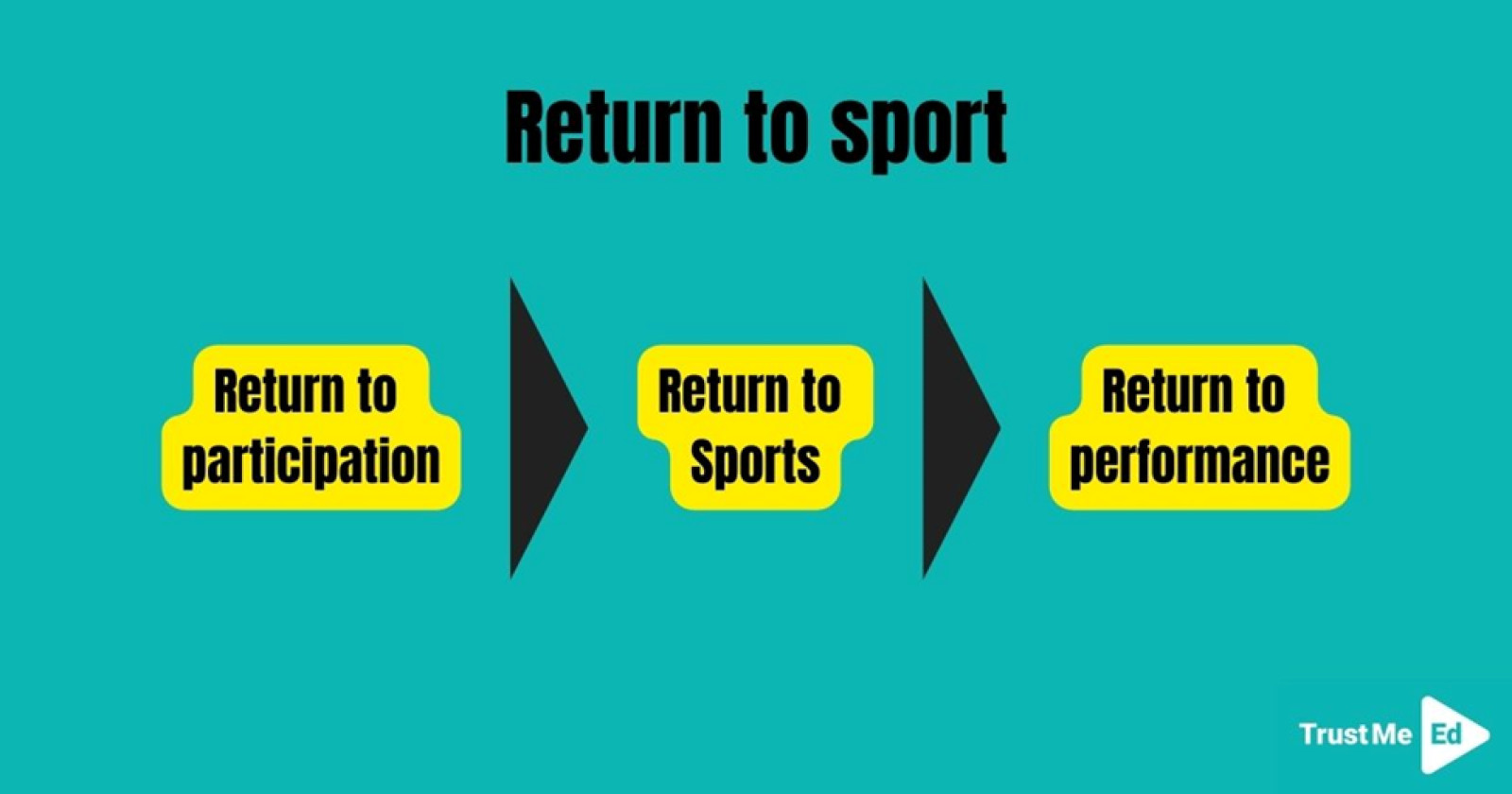
Organization of the Decision-Making Process
Combined decision-making is essential when deciding to return to sport. No single person should decide on the athlete's return to sport. The Medical doctor, surgeon, physical therapist, patient, and other related personnel should be involved in the decision-making process for the decision to be more effective.
In conclusion, after the ACL injury, a step-wise approach to rehabilitation can make the athlete’s return to sports safe and efficient.
We should start with preoperative rehabilitation, move forward to postoperative rehabilitation, and return the athlete to their respective sport through a combined decision. An objective criteria should be followed to decide if the athlete is ready to return to sport.
Time has a prime importance in the return to sport criteria.
Training the athlete in a dynamic and open environment mimicking the respective sports environment can make the athlete capable of performing efficiently in the field. It is a shift from the traditional classic approach to the contemporary and evidence-based approach.
If you want to learn more about ACL reconstruction rehabilitation and the practical applications of the theoretical literature, watch the lecture on ACL Rehabilitation by Bart Dingenen on Trust Me-ed.

Bringing high-quality classes so you can help your patients better. Learn from the world's leading experts, from the comfort of your home. Staying up to date has never been easier.
© 2026 TrustMe. All rights reserved.
We usually answer within a minute.
Ask anything about your membership, certificates or what is in the library.